Welcome to Design4Services – a free on-line resource for service and service operations design, enterprise design, organisation design and business transformation.
Service Operations Design
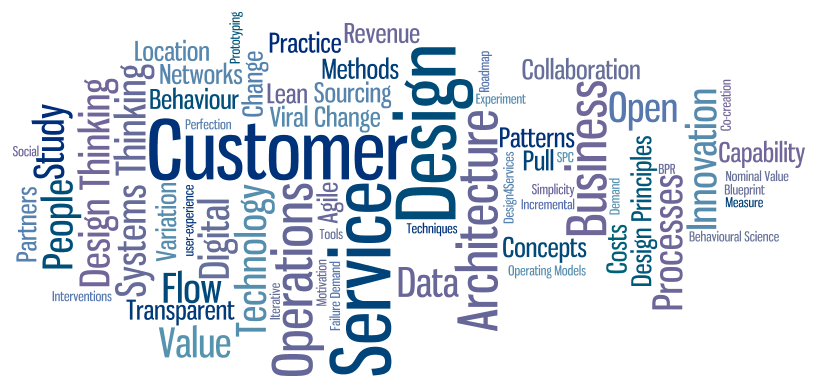
Until fairly recently, service and service operations design was a poor cousin to the design of products and manufacturing processes. But with the growth of the service economy, including the re-orientation of many product-based businesses, this has begun to change.
Unfortunately, this increased focus on services has not necessarily lead to improvements in design. There has been a tendency to simply take the same approaches used so successfully in product design and manufacturing and apply them to services. But services are very different to products, with the customer sitting at the very heart of what is being supplied. This creates a system dynamic and degree of complexity very different from that encountered in the manufacture of goods. Treat a service customer as a standardised unit of production, to be directed and processed in a standardised way (rather than reflecting their specific needs and circumstances), and you should not be surprised if that customer chooses to go elsewhere; or not to use the service as intended.
This site is about a more holistic and customer-focused approach to service and service operations design, that reflects the more intimate relationship between customer and service provider; and the greater variation in demand that typically exists at the point of delivery. It is applicable to all service-orientated environments and all forms of customer – end user (both external and internal) and business-to-business (B2B).
Applied Systems Thinking
At the heart of Design for Services is the application of Systems Thinking to the design and improvement of services and service operations. This provides the conceptual framework, or structure, within which other related Concepts are introduced. These are then carried forward into a set of practical design Methods and Techniques.
In the final section of the site, we look at the Application of these concepts and methods, across various settings, both private and public sector; single and multi-agency; using different patterns of delivery, including the use of outsourcing and shared services; and at the application of technology.
Enterprise Design
The methods presented here are centred on the design and development of an Enterprise Design for your service operation; and the design and development of the products and services that are delivered by the operation, to both external and internal customers.
Clustered around this central approach are a range of related design methods and techniques, covering service and service operations design, transition planning, the management of change and continuous improvement.
Note that the use of the term “Enterprise Design” here also encompasses the terms “Business Architecture”, “Strategic Architecture”, “Enterprise Architecture” and all variants of; Organisation Design and Target Operating Model (TOM) design.
Getting the Most from the Site
Design4Services is unashamedly pluralistic. It will cover material that you may have encountered before under various labels, e.g. Design Thinking, BPR, BPM, Lean and Agile. To get the most from the site, it is important to approach this material afresh. A lot of good concepts and ideas get distorted over time, through mis-interpretation and commercialisation. Here, everything is viewed afresh, through the unifying lens of Systems Thinking.
Design4Services aims to provide short, concise and accessible introductions to each topic. Beyond this, it provides links to additional resources, in the form of further reading and useful (free or low cost) resources published by others; and to other useful sites on service design and improvement.
In addition to the articles, there is a blog providing the latest news and comment on all things service design related.
If you are an organisation looking for some more tailored advice and/or direct assistance, then please visit the Consultancy page.
As with all services, the site can only benefit from a greater understanding of demand. Please spend a few minutes to provide your ideas and feedback, using the contact page.
Design for Services is published under a Creative Commons licence.
About the Author

Tim Manning is an Independent Consultant, with over 25 years experience in enterprise and service design. Tim is based in the UK.
First Published: 7/11/2011
Last Updated:  27/02/2021